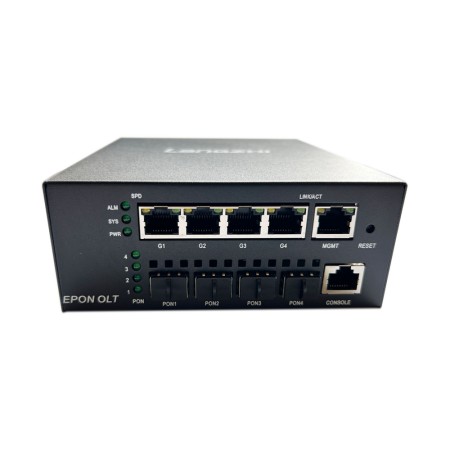
Why small ISPs need a smart OLT investment
For small and medium Internet Service Providers (ISPs), building a fiber-to-the-home (FTTH) network often starts with one critical decision: choosing the right Optical Line Terminal (OLT). An OLT is the heart of your passive optical network (PON)—it aggregates subscriber traffic, manages bandwidth, and determines the scalability of your entire infrastructure. However, with tight budgets and fierce competition from larger carriers, small ISPs must strike a balance between cost, performance, and future-proofing.
In this budget OLT buying guide, we break down the best affordable options for small ISPs, highlight essential features to look for, and share practical deployment tips. Whether you are expanding an existing network or launching a new one, this guide will help you make a cost-effective investment without sacrificing reliability.
What to Look for in a Budget OLT for Small ISPs
When shopping for an affordable OLT, it is tempting to focus solely on the price tag. However, a truly budget-friendly OLT must offer the right mix of performance, port density, and management simplicity. Here are the key evaluation criteria:
- Port count and scalability: For small ISPs, an OLT with 4 to 16 PON ports is usually sufficient. Choose a chassis or fixed-configuration model that allows easy upgrades—adding a line card or stacking units can save you from buying a whole new system later.
- GPON vs. EPON vs. XGS-PON: GPON remains the most cost-effective and widely compatible standard for residential broadband. EPON is also affordable but less common in many regions. XGS-PON (10G symmetrical) is becoming more popular but comes at a higher initial cost—only consider it if your subscriber base demands gigabit+ speeds.
- Management features: A budget OLT should still offer a user-friendly web interface, CLI, or SNMP support. Look for models that provide VLAN configuration, QoS, bandwidth limiting, and basic diagnostics without requiring expensive third-party software.
- Compatibility with ONUs/ONTs: To avoid vendor lock-in, choose an OLT that supports standard OMCI (ONT Management and Control Interface) and works with a wide range of budget ONUs from different manufacturers. This flexibility can significantly lower your total cost of ownership.
- Power efficiency and heat management: Small ISPs often deploy OLTs in small exchanges or even outdoor cabinets. A low-power, fanless or smart-fan model reduces operational costs and improves reliability in non-ideal environments.
Top Affordable OLT Models for Small ISPs
Based on current market offerings and feedback from small ISPs worldwide, the following budget OLT models strike an excellent balance between cost and capability. Prices are approximate and may vary by region and distributor.
1. VSOL OLT-2404 (4-Port GPON)
Price range: $200 – $350
The VSOL OLT-2404 is one of the most popular entry-level OLTs for small ISPs. It features 4 GPON ports (up to 64 subscribers per port), dual Gigabit Ethernet uplinks, and a simple web-based management interface. It supports standard OMCI, making it compatible with most third-party ONUs. Ideal for rural deployments or starting a pilot network, this unit is compact, fanless, and consumes very little power.
2. Huawei SmartAX MA5608T (8-Port GPON/EPON)
Price range (used/refurbished): $400 – $700
While Huawei is known for carrier-grade equipment, the MA5608T is a compact, cost-effective chassis that can be found at attractive prices on the secondary market. It supports GPON, EPON, and even combo ports, and offers advanced features like L3 routing and QoS. Small ISPs often buy refurbished units with a warranty from reputable sellers. Note: management requires some CLI knowledge, but the capability per dollar is outstanding.
3. FiberHome AN5506-04-B (4-Port GPON)
Price range: $250 – $400
FiberHome’s AN5506 series is widely deployed in Asian markets and offers a robust feature set for the price. The 4-port model supports up to 128 subscribers, has dual GE uplinks, and includes a user-friendly web GUI. It also supports dual power supply options for redundancy. Great for small ISPs looking for a reliable, no-frills OLT.
4. ZTE C300 (16-Port GPON/EPON, Chassis)
Price range (used): $800 – $1,500
For small ISPs expecting rapid growth, the ZTE C300 is a popular mid-range chassis that can be expanded with additional line cards. It offers both GPON and EPON support, advanced QoS, and carrier-class reliability. While the initial investment is higher than fixed-port models, its scalability makes it a smart long-term budget choice. Many small ISPs start with a single card and add more as demand grows.
Key Features to Prioritize When Buying on a Budget
Not all features are equally important for a small ISP. Here is what you should prioritize to maximize value without overspending:
- Basic QoS and bandwidth limiting: Ensure your OLT can shape traffic per ONU. This prevents a single heavy user from degrading service for others—essential for customer satisfaction and churn reduction.
- VLAN support: VLANs allow you to segregate different services (internet, IPTV, VoIP) or separate business from residential customers. Even budget OLTs should support 802.1Q VLAN tagging.
- Remote management: A web GUI or cloud-based management platform is a huge time-saver. Some budget OLTs offer a local web interface only, which is fine if you can access the device locally. For distributed networks, consider a model with SNMP or TR-069 support.
- Dual power supply (optional but recommended): For critical links, a redundant power supply prevents outages during power supply failures. Many budget chassis models allow a second PSU.
- Warm spare or stacking: Some budget OLTs support stacking or warm spare configurations. While not a must-have, this feature can improve network uptime at a low additional cost.
Practical Tips for Deploying Budget OLTs
Once you have chosen your budget OLT, follow these best practices to ensure a smooth deployment and long-term reliability:
- Start small but plan for growth. If you expect to add subscribers quickly, choose a chassis-based OLT that allows adding line cards. If your growth is slow, a fixed-port OLT with 4-8 ports will suffice for 1-3 years.
- Use compatible, certified ONUs. To avoid compatibility headaches, test a few different ONU brands with your chosen OLT before scaling deployment. Most budget OLTs work well with VSOL, FiberHome, or Huawei ONUs, but always verify in a lab.
- Invest in a small spool of patch cables and optical power meter. Budget OLTs are sensitive to optical signal quality. Use a power meter to ensure the RX signal is within the acceptable range (-8 to -28 dBm for GPON). Poor fibers cause dropped links and slow speeds.
- Document your configuration. Budget OLTs often lack advanced backup features. Save your configuration files regularly and document VLANs, IP addressing, and port mappings. This saves hours during troubleshooting or replacement.
- Buy from reputable distributors or refurbishers with warranty. Many budget OLTs are available on platforms like Alibaba or from local telecom equipment resellers. Always check seller reviews, request a test unit, and confirm warranty terms. A 1-year warranty is standard for budget gear.
Conclusion: Making the Right Budget OLT Choice
Building a fiber network as a small ISP is an exciting but capital-intensive journey. The good news is that budget OLT options have matured significantly in recent years, offering features once reserved for carrier-grade equipment at a fraction of the price. By focusing on port scalability, management simplicity, and compatibility with cost-effective ONUs, you can build a reliable FTTH network that grows with your subscriber base.
Remember: the most affordable OLT is not always the cheapest one upfront—it is the one that offers the lowest total cost of ownership over 3-5 years. Invest time in researching compatibility, testing gear, and planning your network topology. With the right budget OLT, your small ISP can deliver competitive speeds, win customers, and build a sustainable business in the fiber broadband market.
Ready to explore our selection of budget OLTs for small ISPs? Visit our store to compare models, read reviews, and find the perfect fit for your network. We offer competitive pricing, fast shipping, and expert technical support to help you succeed.